Most EV owners think about charging only after the car comes home.
Then the real questions start.
Where will I charge it?
Can I use the normal socket?
Do I need a fixed charger?
Should I keep one charger in the car?
And if I buy a 7.4 kw ev charger, will my house wiring handle it?
These are not small questions. A charger is not just an accessory. It decides how easy or annoying daily EV use becomes.
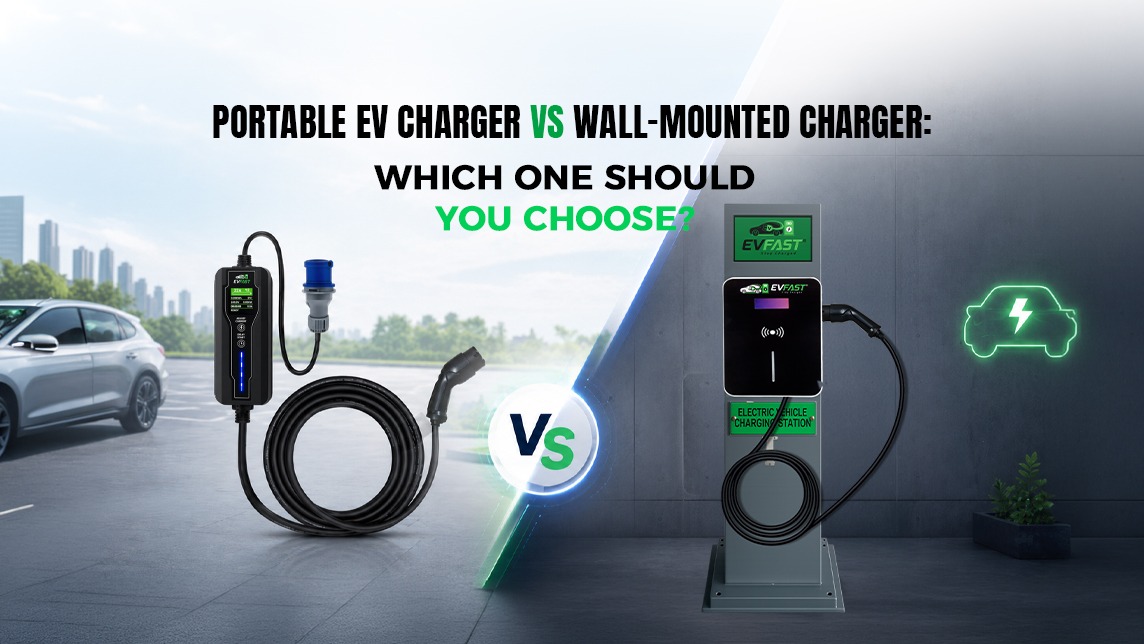
EV-Fast offers different charging options, including portable chargers and wall-mounted chargers. But the right choice depends on your parking space, travel pattern, power connection, and how regularly you charge.
First, Do Not Treat Charging Like Mobile Charging
Many new EV buyers think charging a car is like charging a phone.
Just plug it in and leave it.
However, an EV requires much more power than this. It depends on many things like the socket, cables, grounding, MCB, the charger, and the compatibility of the vehicle with the charging point.
Therefore, before making the choice between a portable charger and a wall-mounted one, there is one question to ask yourself: is your power point capable of handling EV charging?
When A Portable EV Car Charger Makes Sense
A portable ev car charger is useful when you do not always charge at the same place.
Maybe you live in a rented house. Maybe you travel often. Maybe you park at home some days and at the office on other days. Maybe you want a backup charger in the car, just in case.
In these situations, portable charging gives freedom.
You can carry the charger and use it where a suitable power connection is available. That is the main benefit.
But portable does not mean careless.
The socket must be strong enough. The wiring should not be old or loose. Earthing must be proper. And if the charger draws high current, the plug point should be made for that load.
This is especially important with a 7.4 kw ev charger. At this level, the charger needs a proper electrical setup. You should not run it from a weak household socket or temporary extension board.
That is where people make mistakes.
The charger is good. The car is good. But the socket is not ready.
Then heating starts. Tripping starts. Charging becomes slow or unsafe.
When A Wall-Mounted Charger Is Better
A wall-mounted charger makes more sense when your car comes back to the same parking spot every day.
For example, if you charge at home every night, a fixed charger is usually easier. You park the car, plug in, and you are done. No unpacking. No moving the charger around. No checking different sockets every time.
It also looks cleaner.
For homes, offices, showrooms, apartments, and fleet parking, a wall-mounted electric car charger gives a more organised charging setup. The wiring can be planned properly. The charger stays fixed. The user does not have to handle the full kit every day.
This is useful when more than one person may use the charger, or when the charger is installed for regular business use.
A portable charger gives flexibility.
A wall-mounted charger gives routine.
That is the simple difference.
Do You Really Need A 7.4 kW EV Charger?
A 7.4 kw ev charger can be a good option if your EV supports that charging speed and your electrical supply can handle it.
But bigger charger does not always mean faster charging.
Your car has an onboard charger limit. If the car cannot accept 7.4 kW AC charging, then buying a 7.4 kW unit will not magically make it charge faster.
Also, the site must support the load. Proper wiring, earthing, breaker, and installation matter.
So before buying, check two things:
Can your vehicle accept 7.4 kW charging?
Can your site safely supply it?
If both answers are yes, then a 7.4 kW charger can make daily charging much more convenient.
What I Would Suggest To A First-Time EV Owner
For those who have fixed parking at their home, a wall charger can be considered first. It is neater, safer, and more convenient to use on a daily basis.
Those who travel frequently or lack fixed parking can retain a portable charger for additional convenience.
If your daily driving is high, look at a faster AC charger, but only after checking your vehicle and power connection.
For many EV owners, the best setup is not one or the other.
It is this:
Use a wall-mounted charger for daily charging.
Keep a portable charger for backup or travel.
That way, you are not stuck if your regular charging point is not available.
Final Thoughts
Choosing a charger is not only about price.
It is about how you actually use your EV.
A portable charger helps when your charging location changes. A wall-mounted charger works better when you charge daily at one fixed place. A 7.4 kw ev charger can be useful, but only when your car and electrical setup support it properly.
So before buying any electric car charger, check your parking, wiring, earthing, driving routine, and vehicle charging limit.
The right charger is the one that fits your daily life.
Not just the one with the biggest number on the box.